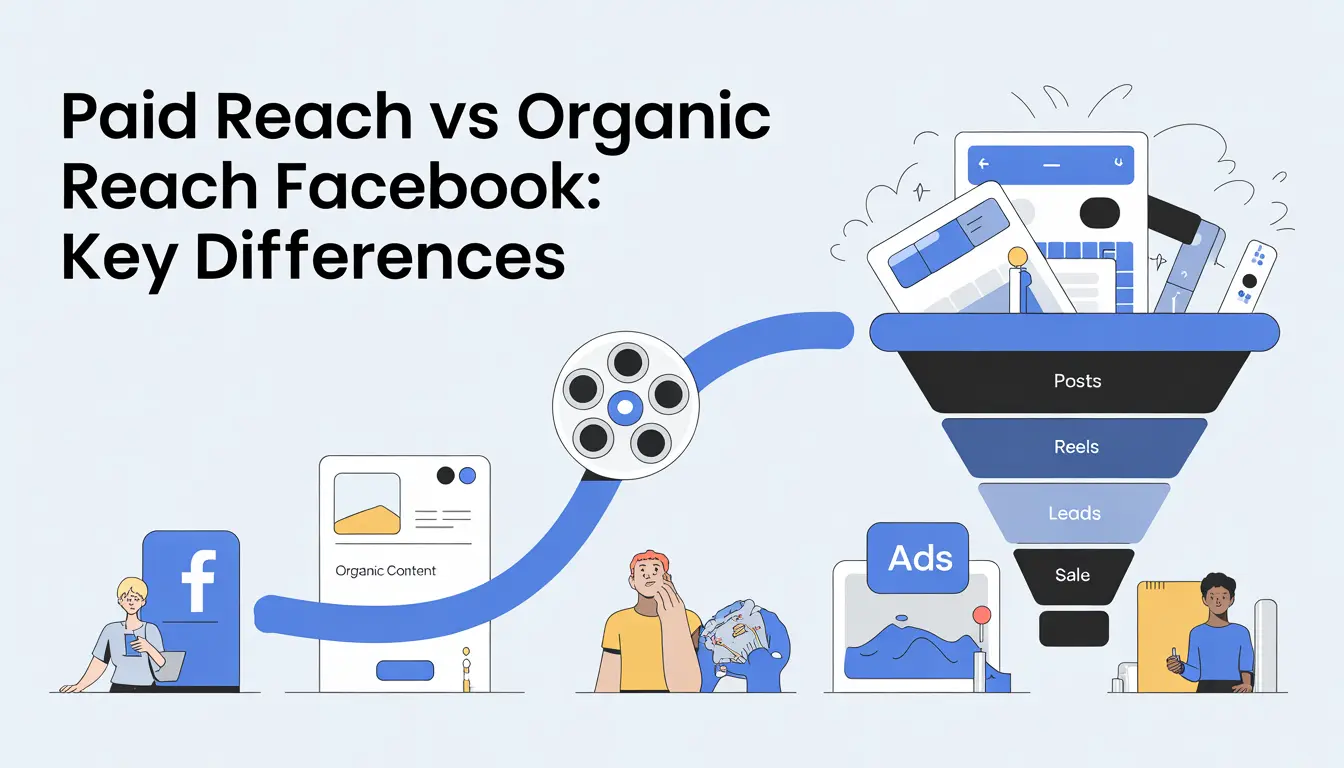

Introduction
A well-crafted marketing strategy in Facebook is the key to turning a social media presence into tangible business results. Did you know that in 2026, businesses are still seeing an average ROI of $4–$7 for every $1 spent on Facebook marketing?
Facebook remains the “big cheese” of social media, boasting over 3.08 billion monthly active users, making it the ultimate platform for connecting with your target audience and delivering measurable results.
Many businesses find it difficult to turn their Facebook activities into growth. They often face issues such as low engagement, ineffective ad performance, and irregular content scheduling, which frustrate brands and leave them uncertain about how to maximize the platform’s potential.
This guide aims to change that. It provides a step-by-step marketing strategy in Facebook, including how to develop a solid Facebook marketing plan and apply proven tactics and content strategies that yield actual results. By the end, you’ll have practical tips and real-world examples to implement right away to increase engagement, generate leads, and expand your business on Facebook.
What is a Marketing Strategy in Facebook?
A Facebook marketing strategy is not just a collection of random posts or boosted ads. It is a comprehensive plan that outlines how your brand will leverage Facebook to achieve specific business objectives, such as generating leads, increasing sales, building brand authority, or retaining customers.
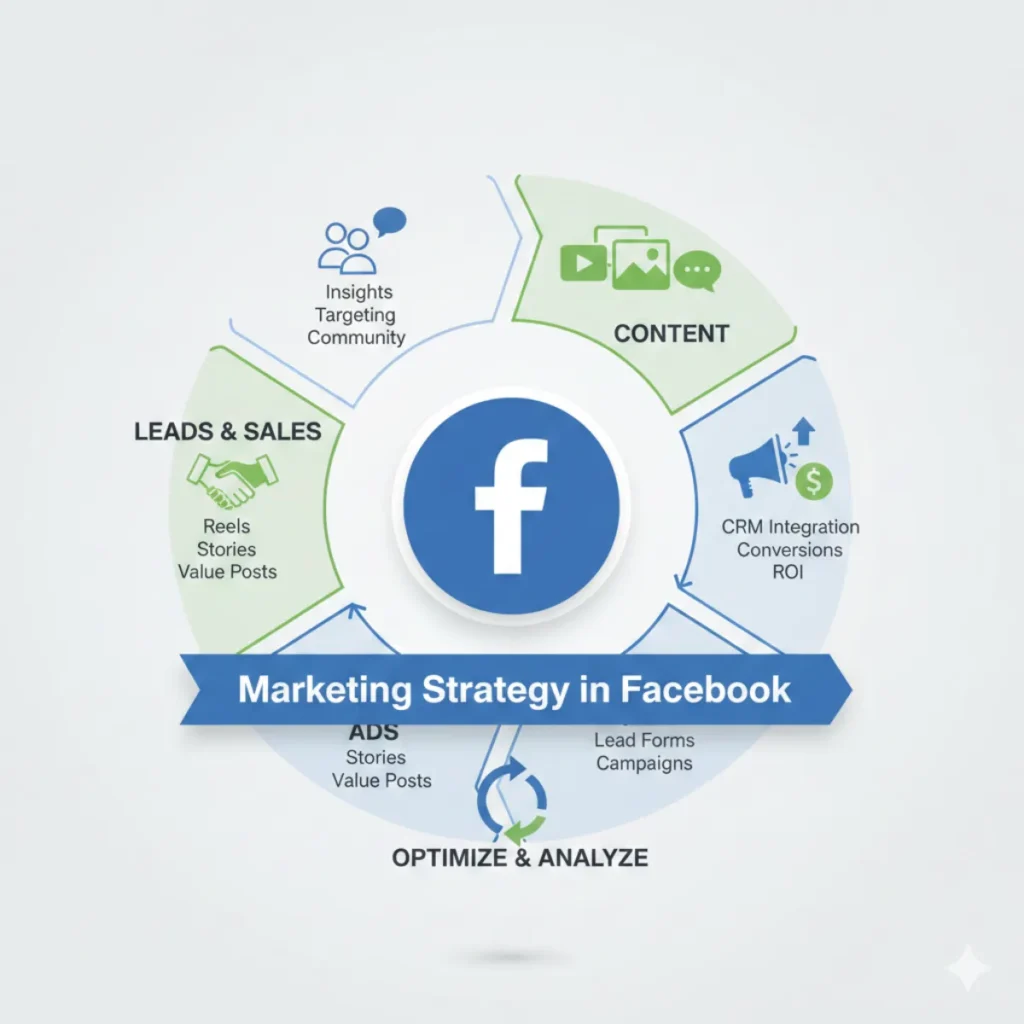
In 2026, when organic reach is harder to achieve and AI-driven competition is fiercer than ever, a documented strategy serves as your North Star. It ensures that every post, ad, and campaign is intentional, measurable, and directly linked to your bottom line. Without a clear strategy, even the best Facebook marketing techniques will fail to deliver consistent ROI.
Strategy vs. Plan vs. Tactics: Understanding the Difference
A significant reason businesses find it challenging on Facebook is the confusion among strategy, plan, and tactics. These terms differ, and mixing them up wastes resources and leads to uneven outcomes.
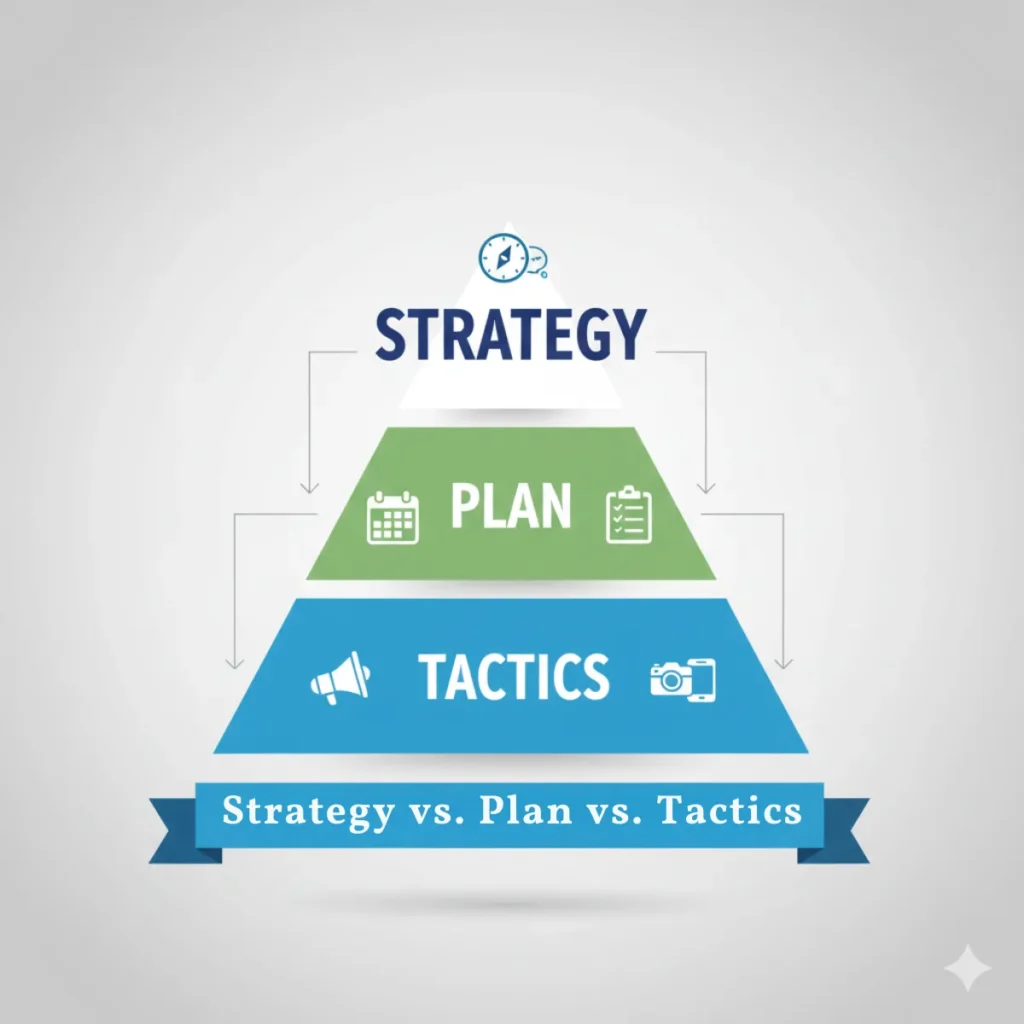
Facebook Marketing Strategy (The “Why”)
This is your long-term direction. It defines:
- Your target audience and buyer personas.
- Your unique value proposition.
- Your core business goals.
Example: “Position our brand as the #1 local authority in Miami real estate within 12 months.”
Facebook Marketing Plan (The “What”)
This is the execution roadmap. It translates strategy into structure by defining:
- Campaign types.
- Budget allocation.
- Content themes.
- Posting and ad timelines.
A solid Facebook marketing plan answers what you’ll run and when, monthly, quarterly, or annually.
Facebook Marketing Tactics (The “How”)
These are the daily actions that bring the plan to life. Examples include:
- Carousel ads for property listings.
- Weekly Facebook Live Q&A sessions.
- Retargeting websitevisitors with video ads.
- Messenger automation for lead follow-ups.
These are the Facebook marketing tactics and techniques that bring your vision to life on the ground.
How a Marketing Strategy in Facebook Aligns with Business Goals
A successful marketing strategy in Facebook should never exist in isolation. It must integrate seamlessly with your overall business goals and sales system, rather than functioning independently.
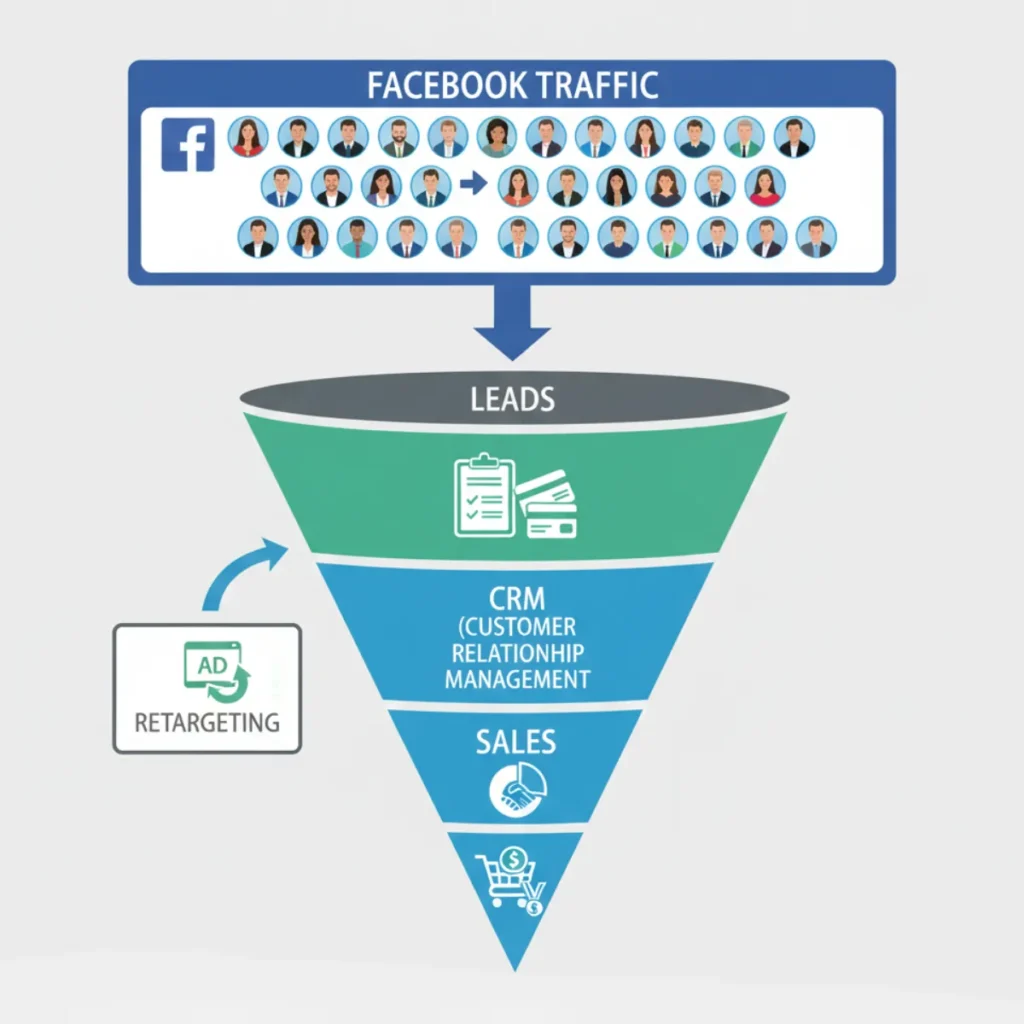
Lead Generation
- Using Facebook Lead Forms connected directly to your CRM.
- Retargeting high-intent users with follow-up offers.
Customer Support & Retention
- AI-powered Messenger bots handling FAQs.
- Automated responses that enhance customer experience and response time.
Brand Awareness
- Top-of-funnel video and storytelling content.
- Ensuring your brand is the first to come to mind when buyers are ready to convert.
This alignment transforms Facebook from “just another social platform” into a core revenue-generating channel within your overall social media marketing strategy in Facebook.
Why Businesses Need a Facebook Marketing Strategy
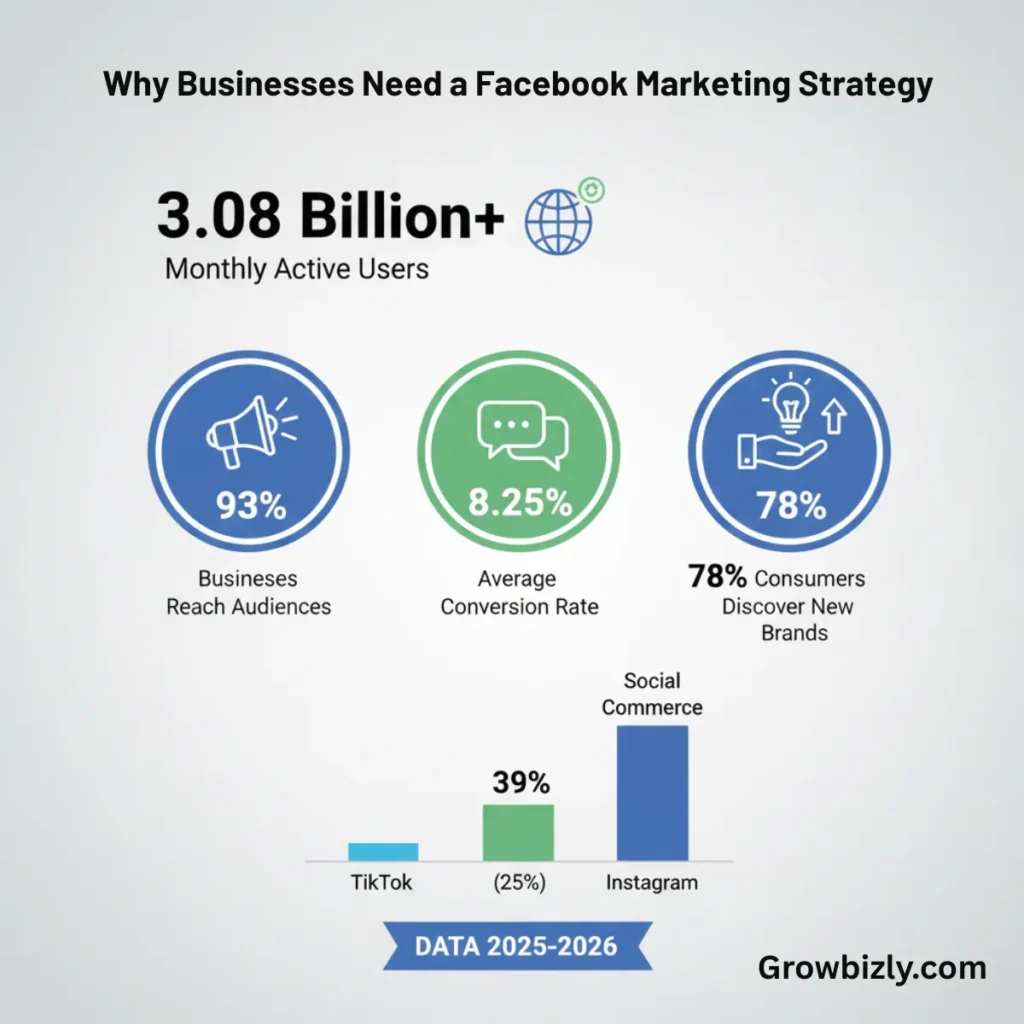
A clear marketing strategy in Facebook is no longer optional it’s a growth requirement. With rising ad costs, declining organic reach, and AI-powered competition, businesses that operate without a structured Facebook marketing strategy waste time, money, and opportunities.
A documented strategy ensures every post, ad, and campaign supports a measurable outcome, not just likes or comments, but real business growth.
Unmatched Reach to the Right Audience
Facebook continues to provide one of the most extensive and accurate targeting ecosystems in digital advertising. A well-crafted Facebook marketing plan allows businesses to reach people based on location, interests, behaviours, life events, and purchasing intent.
Example:
A local service business can target homeowners within a 10-mile radius who recently searched for related services, something few platforms can match at scale.
Result: More visibility → better-qualified traffic → higher ROI.
Higher Engagement Through Strategic Content
Random posting doesn’t build an engagement strategy, but it does. A proper Facebook marketing strategy aligns content with audience intent using a structured Facebook content strategy.
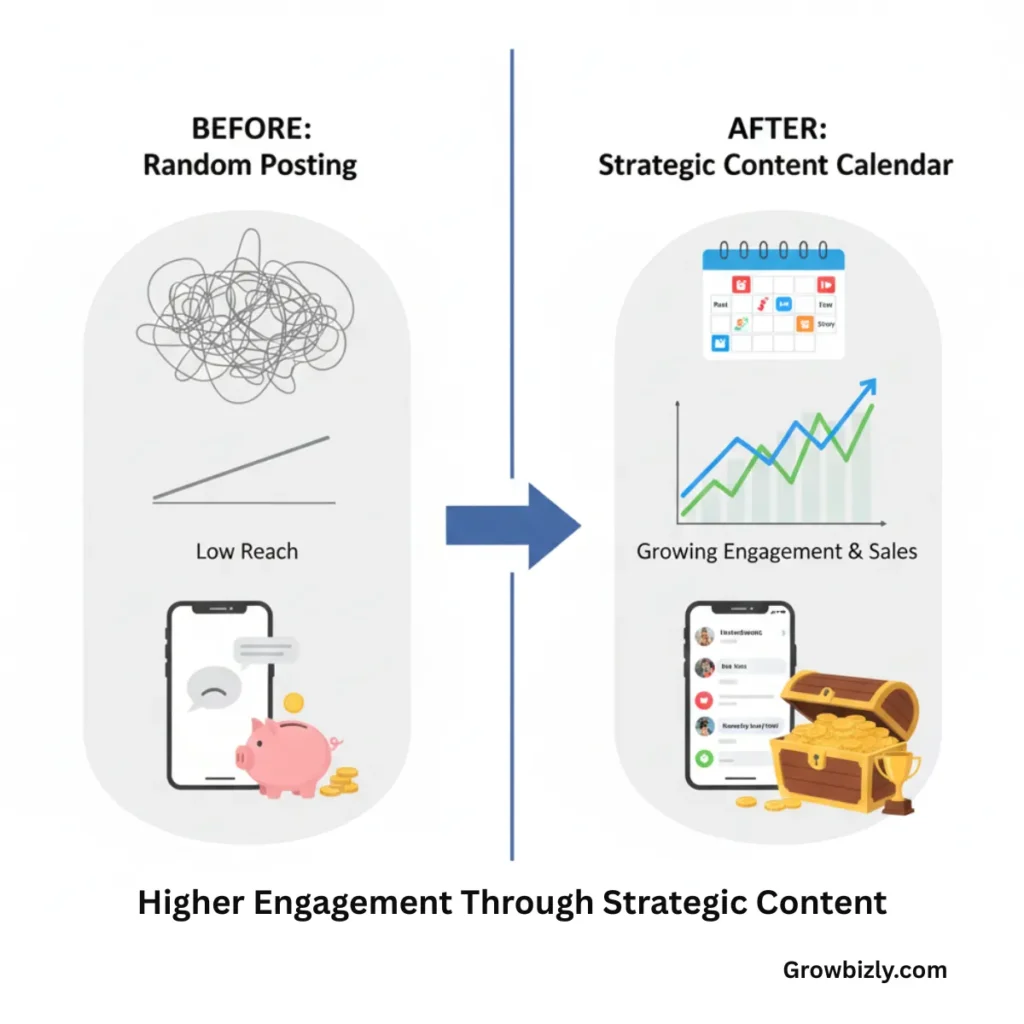
Businesses that plan content around education, social proof, and storytelling consistently see:
- Higher post interactions.
- More shares and saves.
- Stronger brand trust.
Mini Case:
A fitness brand shifted from promotional posts to educational Reels and community stories. In 60 days, this change led to a 62% rise in engagement without any increase in ad spend.
Stronger Brand Awareness & Authority
Consistency builds familiarity. A strategic approach ensures your brand appears repeatedly across feeds, videos, and stories without coming across as spammy.
Using proven Facebook marketing techniques such as video storytelling, community posts, and remarketing, brands stay top of mind when customers are ready to buy.
Key Insight:
People may not convert on the first interaction, but they remember brands that consistently deliver value.
Scalable Lead Generation & Sales
One of the most significant advantages of a structured Facebook marketing plan is the predictability of lead generation.
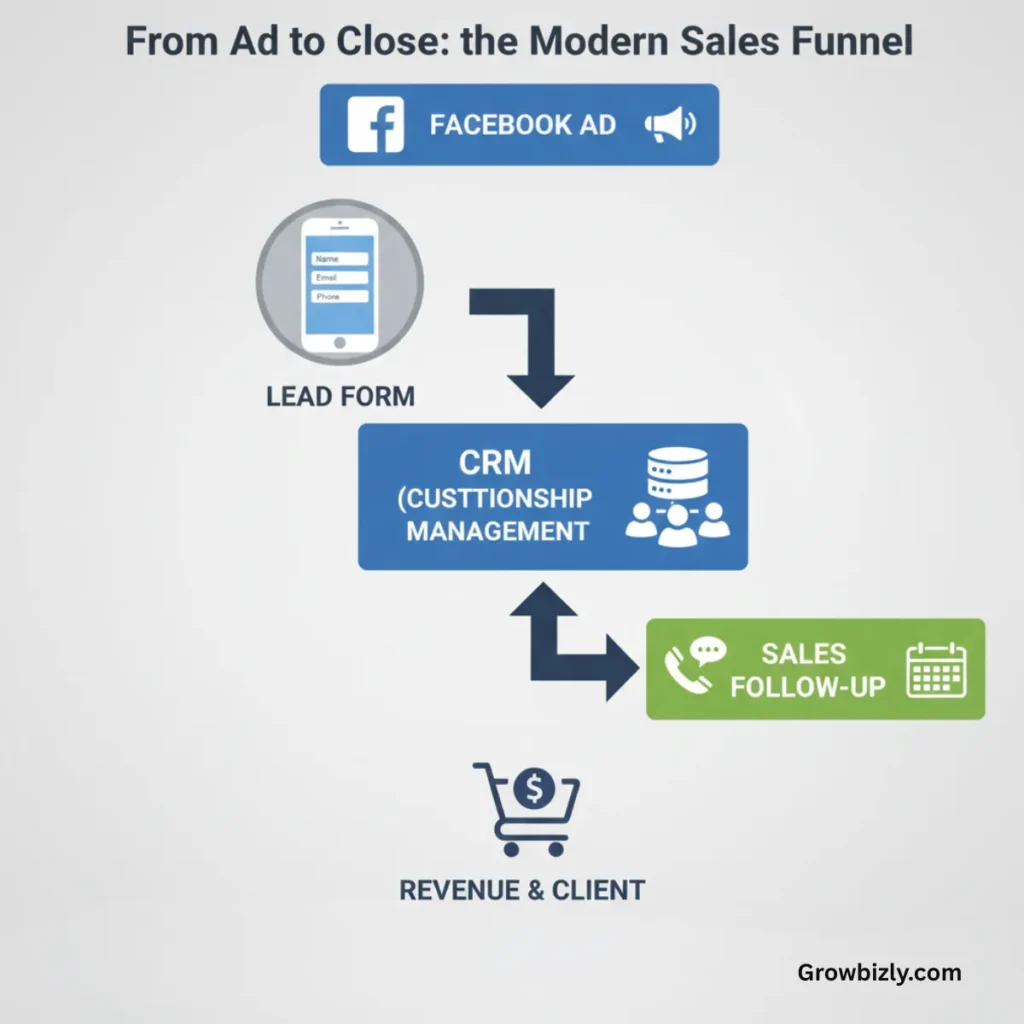
With the right Facebook marketing tactics, businesses can:
- Capture leads via instant forms.
- Retarget website visitors.
- Nurture prospects with Messenger automation.
Mini Case:
A real estate agency used video ads + retargeting to promote local listings. Result: 3× more qualified leads at a lower cost than Google Ads, proving the power of a focused Facebook marketing strategy for real estate.
Data-Driven Decisions (Not Guesswork)
Facebook provides deep performance data. A clear strategy helps businesses focus on metrics that matter:
- Cost per lead.
- Conversion rate.
- Return on ad spend.
Instead of chasing vanity metrics, companies optimize based on real outcomes, turning Facebook into a measurable channel within their social media marketing strategy.
Building Your Facebook Marketing Plan
A successful marketing strategy in Facebook only works when a clear, actionable plan supports it. This is where strategy turns into execution. Your plan defines what you’ll do, who you’ll target, and how you’ll measure success, so every action moves the business forward.
Define Clear Goals: Awareness vs. Lead Generation
Before posting or running ads, you must decide what success looks like. Different goals require different Facebook marketing tactics.
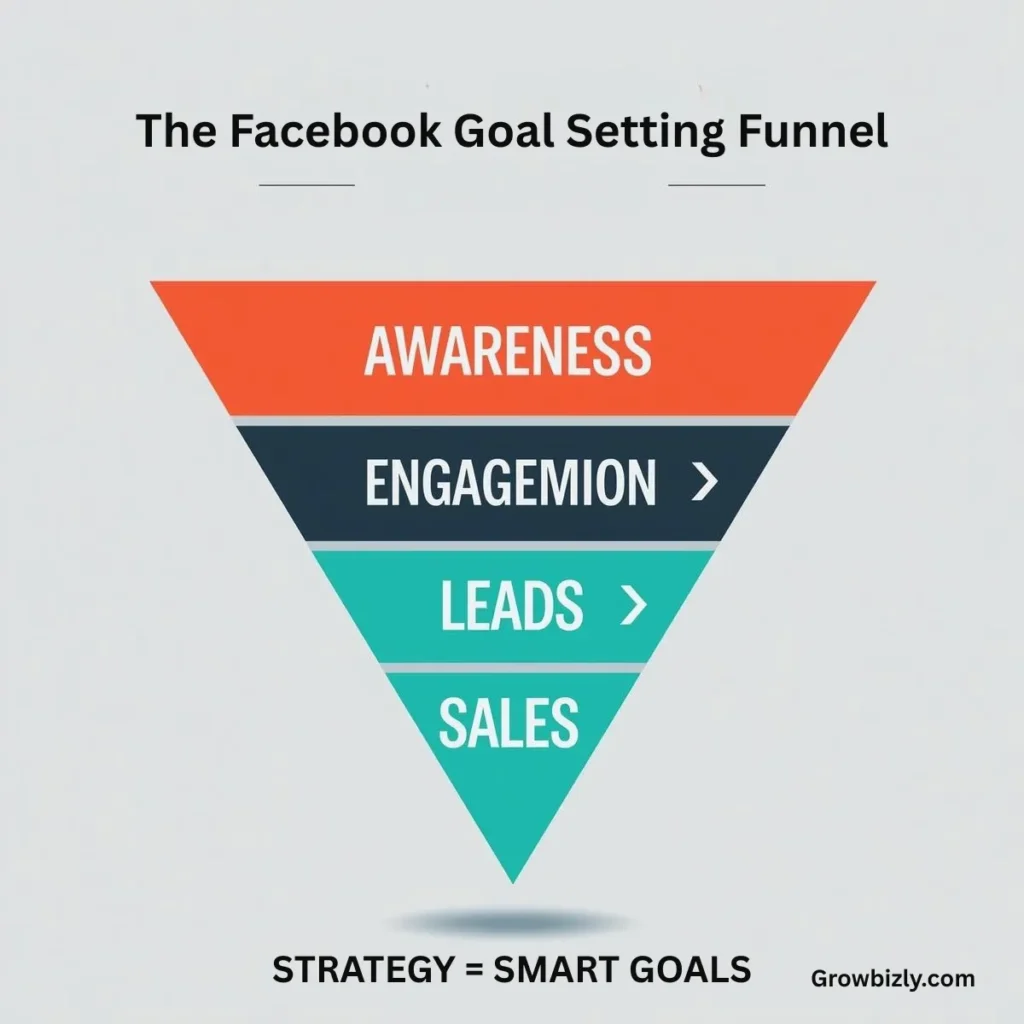
Common Facebook goals:
- Brand Awareness: Reach new audiences, increase visibility.
- Engagement: Build trust through comments, shares, and saves.
- Lead Generation: Collect emails, phone numbers, and inquiries.
- Sales: Drive conversions to landing pages or Messenger.
Use SMART Goals
Your goals should be:
- Specific: “Generate 100 leads per month.”
- Measurable: Cost per lead under $5.
- Achievable: Based on budget and audience size.
- Relevant: Supports overall business growth.
- Time-bound: Within 30 or 90 days.
Example:
👉 “Generate 150 qualified leads in 60 days using Facebook Lead Ads for local services.”
This clarity ensures your Facebook marketing plan doesn’t chase vanity metrics.
Know Your Audience (This Is Where Most Businesses Fail)
Even the best content won’t convert if it’s shown to the wrong people. A strong Facebook business page marketing strategy starts with deep audience understanding.
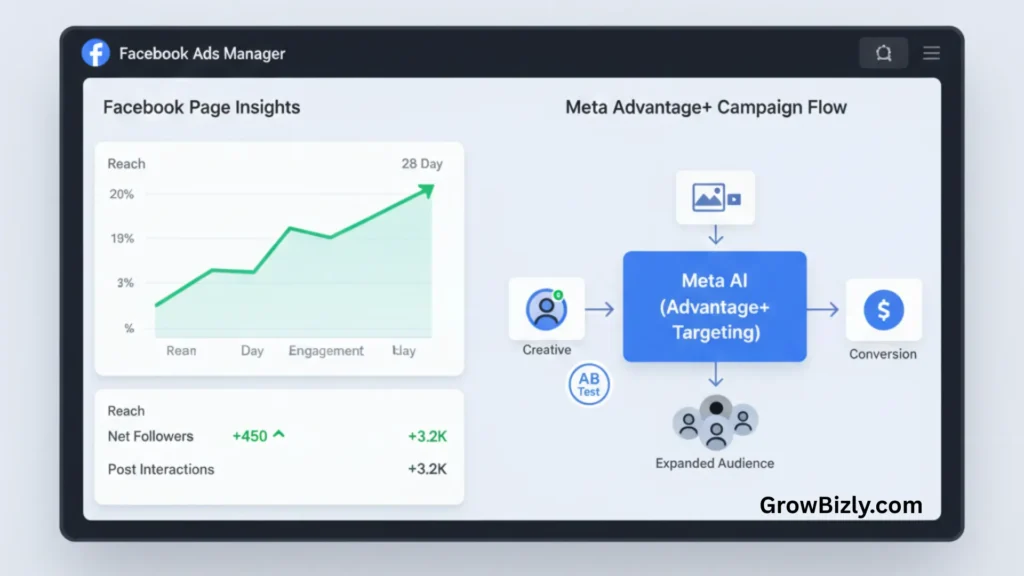
Use Facebook & Meta Tools
- Facebook Insights: Analyse age, gender, location, and content engagement
- Meta Advantage+ Targeting: Let Meta’s AI optimize targeting based on conversion data
- Interest & Behaviour Targeting: Job titles, purchase behaviour, life events, and interests
Pro Tip: Start broad with Advantage+ and narrow down based on performance data. This is one of the most effective modern Facebook marketing techniques.
Create the Right Content Balance (80/20 Rule)
Posting too many sales messages kills engagement. Posting only educational content kills conversions. The solution? Balance.
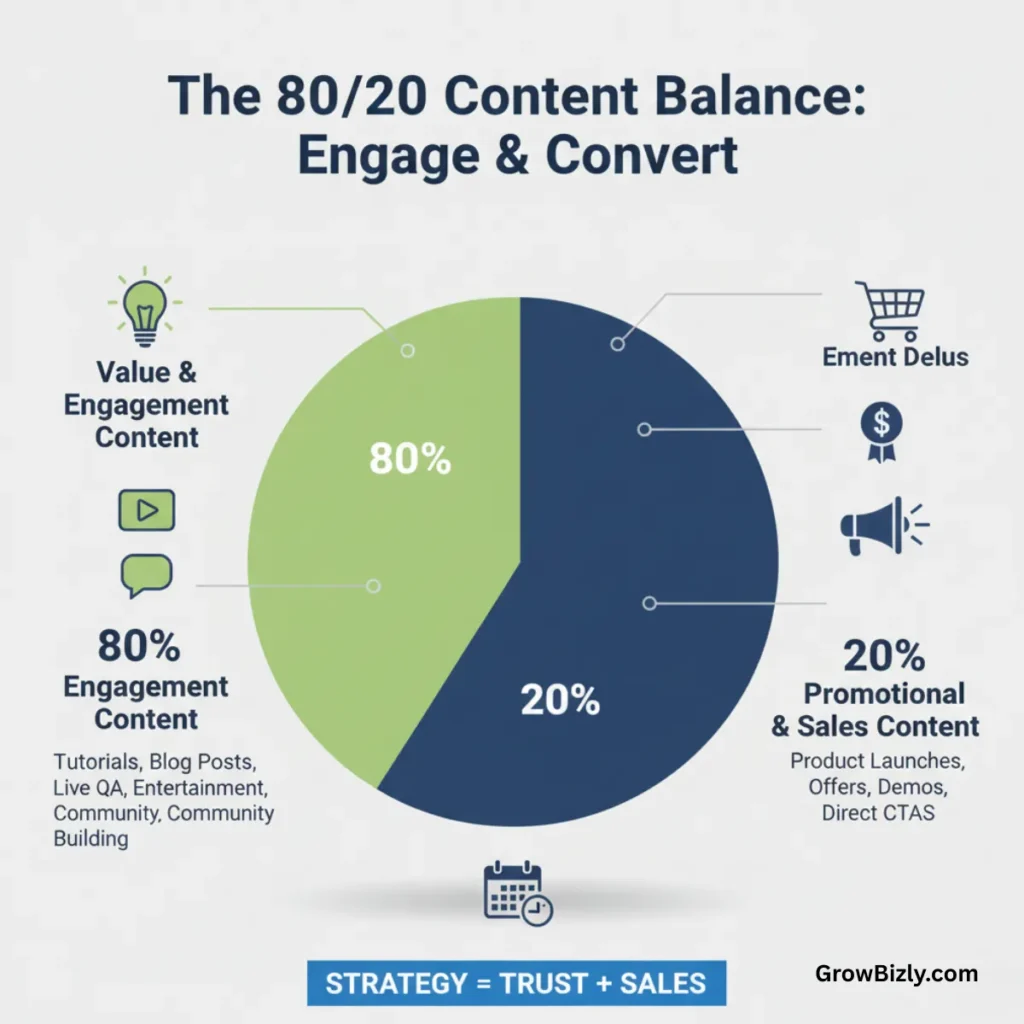
The 80/20 Content Rule:
- 80% Value-Based Content:
- Educational tips.
- Behind-the-scenes posts.
- Stories, reels, and community content.
- 20% Promotional Content:
- Offers
- Lead magnets
- Product or service promotions
This balance underpins a long-term Facebook content strategy that builds trust before asking for the sale.
Example Content Mix:
- Monday: Educational post.
- Wednesday: Short Reel or tip.
- Friday: Soft promotion or lead magnet.
Why This Facebook Marketing Plan Works
When goals, audience targeting, and content balance align:
- Engagement increases naturally.
- Ads become cheaper and more effective.
- Your page supports both organic and paid growth.
This is how a structured plan strengthens your overall social media marketing strategy for Facebook.
Step-by-Step Facebook Marketing Strategy
Step 1: Optimize Your Facebook Business Page
Your marketing strategy in Facebook will fail fast if your business page isn’t optimized. Think of your Facebook Page as a 24/7 landing page. Before running ads or posting content, this foundation must be conversion-ready.
A properly optimised page builds trust, improves engagement, and boosts results across your entire Facebook marketing plan.
Profile & Cover Image Optimization
Your profile and cover image are your first impression. If they don’t instantly communicate value, visitors won’t click further.
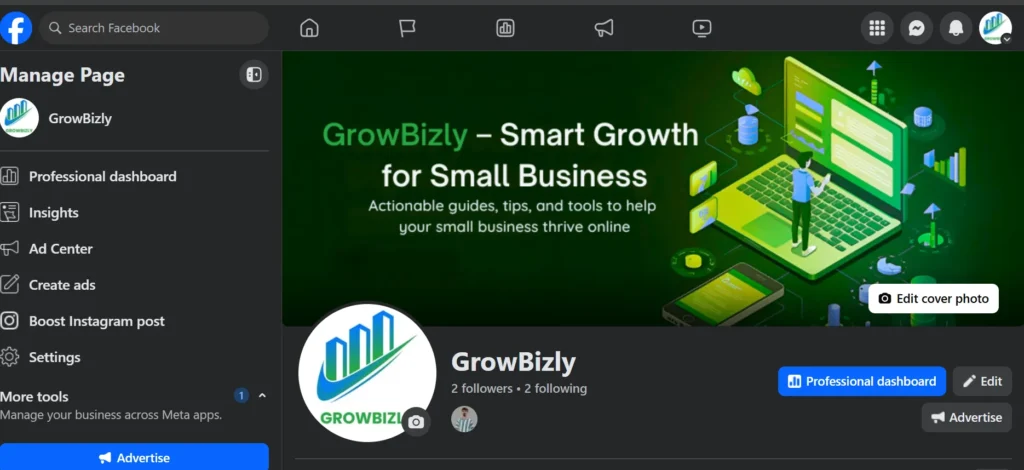
Profile Image Best Practices
- Use a transparent logo (brands) or professional headshot (personal brands)
- High contrast, centred, recognizable at small sizes
- Consistent with the website and other social platforms
Goal: Brand recognition + credibility
Cover Image Best Practices
Your cover should answer one question fast: “Why should I follow or message this page?”
High-converting cover ideas:
- Core offer or benefit (“Get 30% More Leads with Facebook Ads”)
- Social proof (client logos, testimonials)
- CTA direction (“👇 Book a Free Strategy Call”)
Pro Tip: Update your cover image for campaigns, seasonal offers, or lead magnets. This is an underrated Facebook marketing tactic.
About Section (Silent SEO + Trust Builder)
Most businesses ignore this section. Big mistake.
Your About section should:
- Clearly explain what you do
- Include your primary keyword naturally
- Show authority and relevance
Structure Example:
- One-line value proposition
- Who do you help
- How do you help
- Trust signal (experience, results, location)
This strengthens your Facebook business page marketing strategy and improves discoverability.
CTA Buttons (Turn Visitors into Leads)
Your CTA button is where attention becomes action.
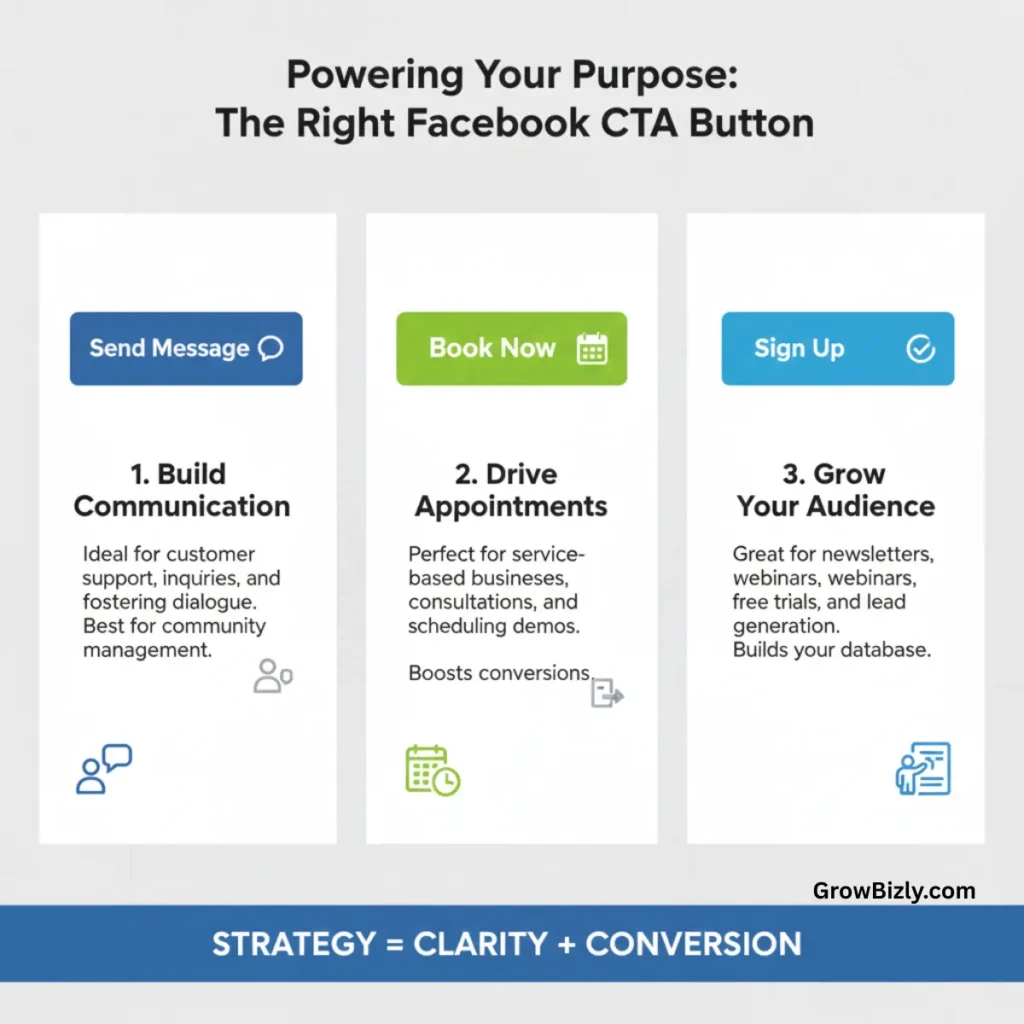
Best CTA options based on goals:
- Lead Generation: “Contact Us”, “Sign Up.”
- Sales: “Shop Now”, “Book Now.”
- Service Businesses: “Send Message, “Call Now.”
Advanced Tip: Connect the CTA to:
- Messenger automation
- Booking calendar
- Lead form
This single button can outperform multiple posts when optimized correctly.
Tabs & Page Layout Optimization
Tabs help guide visitors to the right action without confusion.
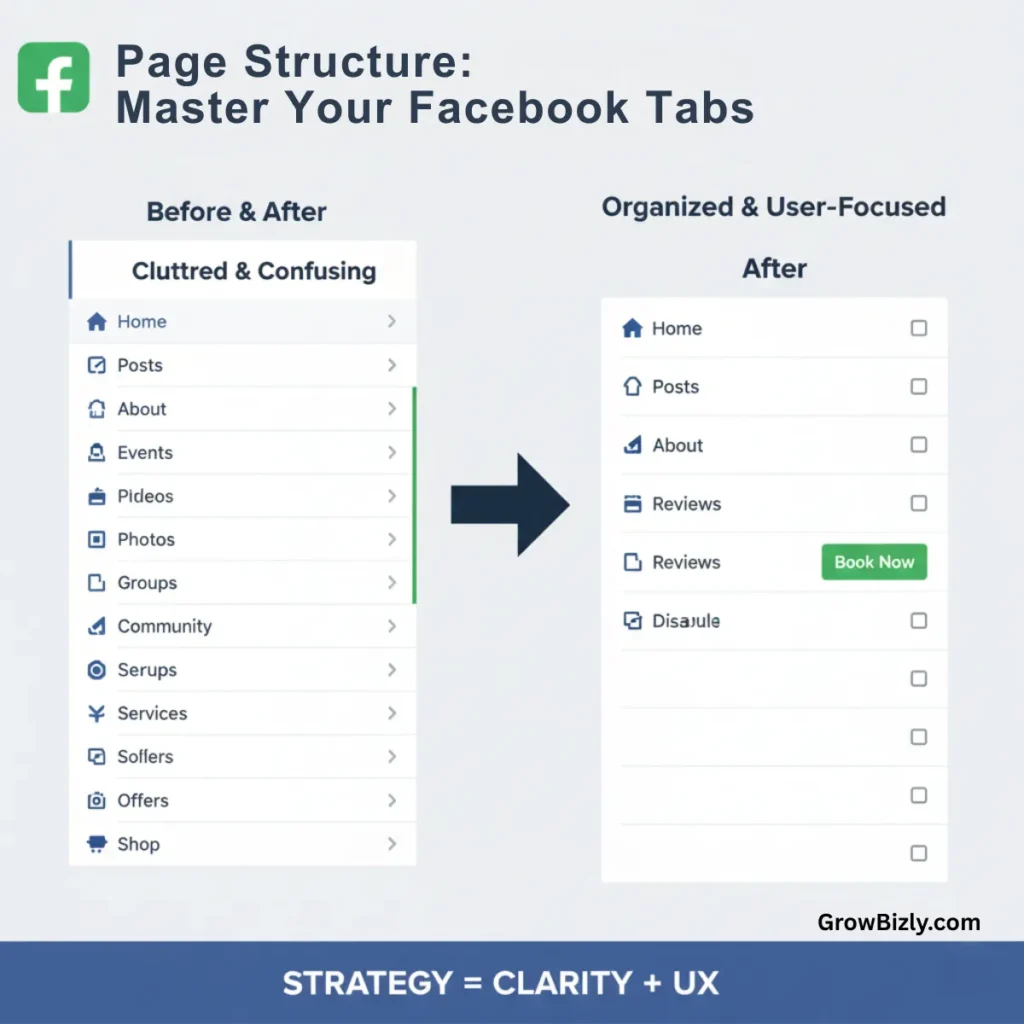
Recommended tabs to enable:
- Services
- Reviews
- About
- Shop (if applicable)
- Events or Videos
Remove unused tabs to keep the page clean and conversion-focused. This supports a smooth social media marketing strategy for Facebook.
Why This Step Matters
Before content, ads, or funnels, page optimisation is non-negotiable. A strong page:
- Increases ad trust score
- Improves organic engagement
- Converts profile visitors into leads
This is the foundation of every scalable Facebook marketing strategy.
Step 2: Content Strategy
An effective marketing strategy in Facebook in 2026 is no longer about how often you post; it’s about how intentionally you use each content format. With organic reach tighter and competition fueled by AI, a strong Facebook content strategy must blend Social Search optimization, authentic storytelling, and consistent value delivery.
If your content seems random, engagement declines. However, if it’s strategic, Facebook boosts your reach, trust, and conversions.
Mastering Modern Facebook Content Formats
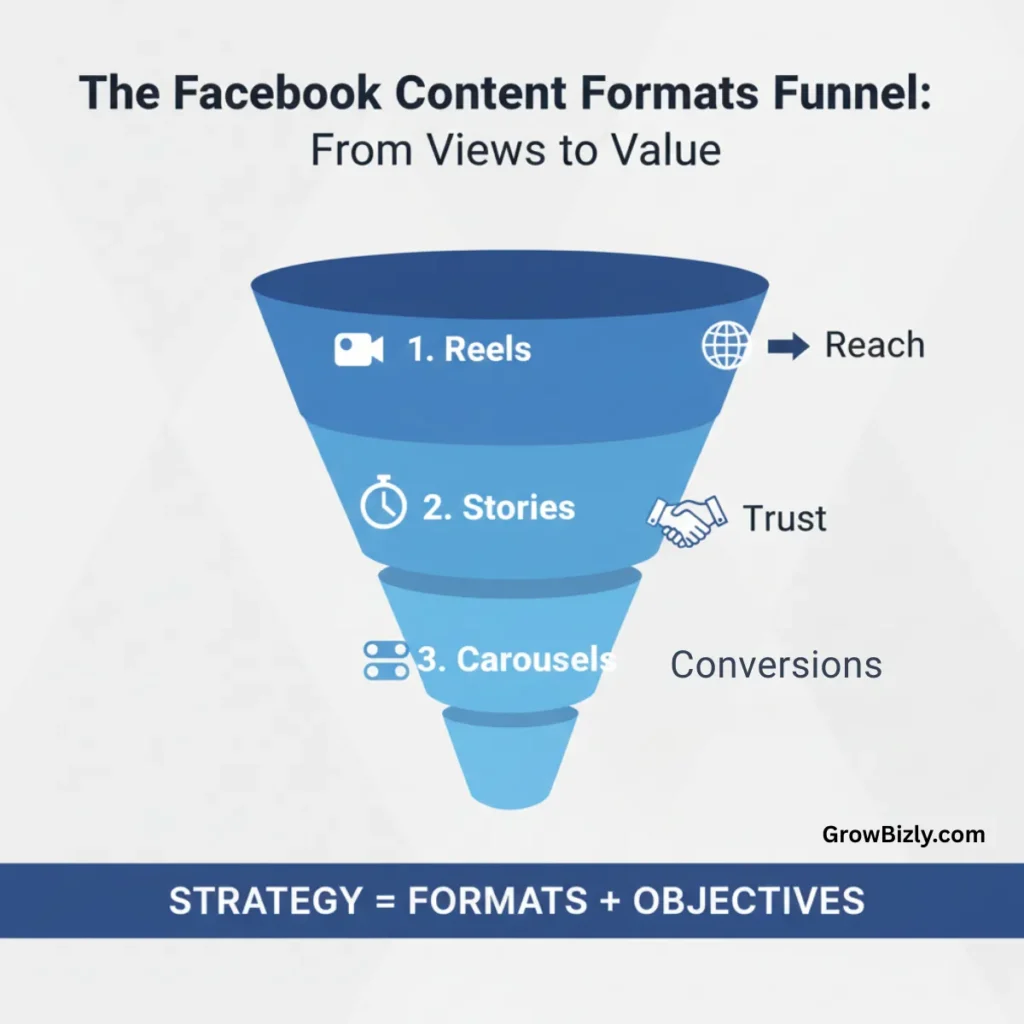
In 2026, Facebook organizes content performance into three precise algorithm “buckets.” A high-performing Facebook marketing plan uses all three to move users from awareness to action.
🔹 Facebook Reels (The Reach King)
Short-form vertical videos are your #1 discovery tool. Reels help you reach cold audiences who don’t follow you yet.
Best uses:
- Quick tips
- Industry myths
- Trending sounds + hooks
- Local insights (compelling for real estate)
📌 Example: “3 Facebook marketing tactics that most businesses ignore in 2026”
🔹 Facebook Stories (The Nurture Tool)
Stories sit at the top of the feed and offer daily visibility.
Best uses:
- Behind-the-scenes clips
- Polls & questions
- Limited-time offers
- Daily thoughts or quick wins
Stories build familiarity, essential for any long-term Facebook marketing strategy.
🔹 Carousel & Photo Posts (The Conversion Tool)
Carousels slow the scroll and encourage saves.
Best uses:
- Step-by-step guides
- Educational breakdowns
- Testimonials
- Property features (for real estate brands)
📌 Example: “Swipe → How to build a Facebook marketing plan that actually converts.”
The Three Pillars of Value (What to Post Consistently)
Stop guessing. High-performing Facebook marketing ideas always fall into one of these three pillars:
1️. Educational Content (Expertise)
Position your brand as the authority.
Examples:
- Tutorials
- Industry updates
- Mistakes to avoid
- Strategy breakdowns
📌 “How a small business used a Facebook marketing strategy to double leads.”
2️. Behind-the-Scenes Content (Authenticity)
Human content wins in an AI-heavy feed.
Examples:
- Team moments
- Day-in-the-life videos
- Campaign prep
- Real struggles & wins
This pillar dramatically increases trust, especially in a Facebook marketing strategy for real estate.
3️. Social Proof Content (Trust & Conversion)
People believe results, not promises.
Examples:
- Client testimonials
- User-generated content
- Case studies
- Before/after results
📌 “How this local agent used Facebook real estate marketing strategies to close five deals in 60 days.”
Storytelling & Consistency Tips (Where Most Brands Fail)
The 1.7-Second Hook Rule
You have 1.7 seconds to stop the scroll.
Start with:
- A bold claim
- A painful truth
- A direct question
📌 “Why 90% of Facebook content fails and how to fix it.”
Serialization (Algorithm + Loyalty Hack)
Turn content into a recurring series:
- “Weekly Facebook Growth Tips.”
- “Real Estate Reel of the Week.”
- “Marketing Myth Mondays.”
This trains both the algorithm and your audience to expect your content.
Intelligent Scheduling (Consistency Without Burnout)
Consistency beats volume.
Recommended rhythm:
- 3–4 feed posts/week
- 2–3 reels/week
- Daily stories (light & casual)
Schedule using Meta Business Suite when your audience is most active. This supports a sustainable social media marketing strategy for Facebook.
Step 3: Paid Campaigns & Ads (Scaling with Precision)
Organic reach builds trust, but paid ads scale results. A complete marketing strategy in Facebook uses ads not to “boost visibility,” but to systematically generate leads, sales, and bookings. In 2026, Meta’s AI makes advertising more potent than ever if you use the right Facebook marketing tactics.
Boosted Posts vs. Ads Manager Campaigns
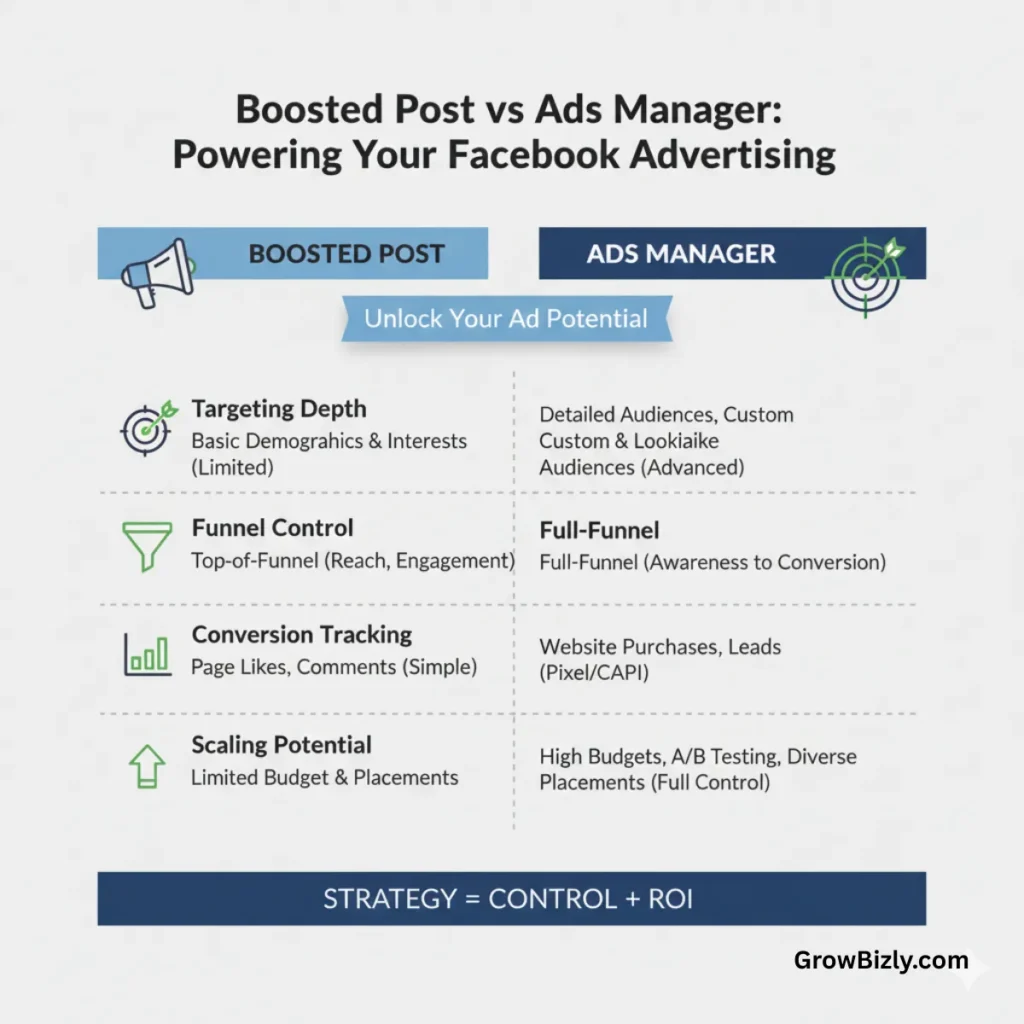
One of the biggest mistakes businesses make is relying only on the “Boost Post” button.
🔹 Boosted Posts (Entry-Level Visibility)
Best for:
- Promoting high-engagement posts
- Increasing reach on social proof
- Warming up audiences
Limitations:
- Limited targeting
- No funnel control
- Weak optimization
Boosted posts are fine for awareness, but they are not a complete Facebook marketing strategy.
🔹 Ads Manager Campaigns (Real Growth Engine)
Ads Manager is where serious Facebook marketing techniques live.
Why Ads Manager wins:
- Full funnel control (TOF, MOF, BOF)
- Advanced targeting
- Conversion tracking
- Creative testing
- Better ROI optimization
📌 Rule of thumb: Boost for engagement. Use Ads Manager for revenue.
Advanced Targeting Options That Actually Convert
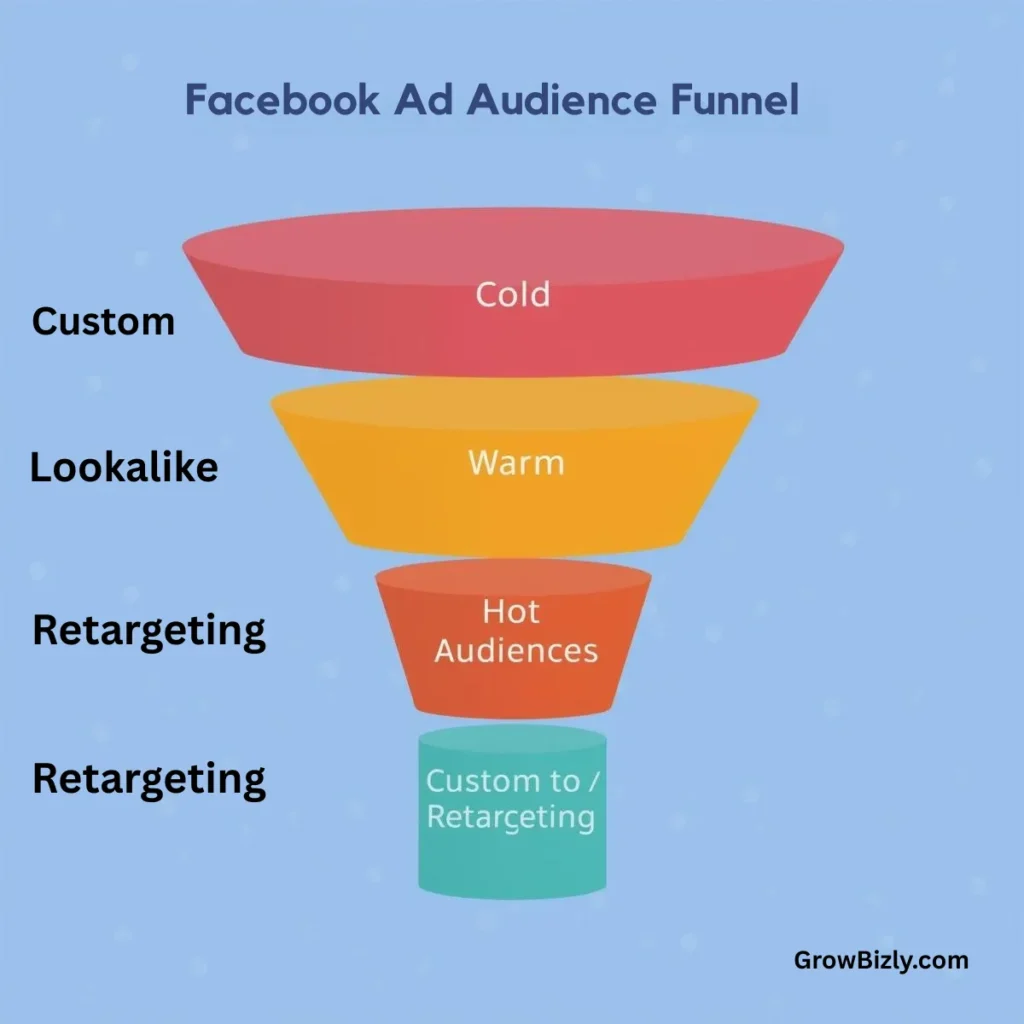
Meta’s targeting is the backbone of high-ROI Facebook marketing tactics.
🔹 Custom Audiences (Warm Traffic)
Target people who already know you:
- Website visitors
- Video viewers
- Email subscribers
- Instagram engagers
These audiences convert 2–5x as often as cold traffic.
🔹 Lookalike Audiences (Scale What Works)
Create new audiences based on your best customers.
Best sources:
- Past buyers
- Lead form completions
- High-value website visitors
This is essential for scaling any Facebook marketing plan.
🔹 Retargeting (Where Profits Are Made)
Retarget users who:
- Visited your website
- Watched 50%+ of your video
- Opened but didn’t submit a lead form
📌 Especially powerful for a Facebook marketing strategy for real estate, where buying decisions take time.
High-Converting Ad Creative Tips (Copy, Visuals & CTAs)
Even perfect targeting fails without strong creative.
Ad Copy That Stops the Scroll
Use simple frameworks:
- PAS (Problem → Agitate → Solution)
- Hook → Value → CTA
📌 Example:
“Still posting on Facebook with no leads? Here’s the exact Facebook marketing tactic we use to generate daily inquiries.”
Visuals That Convert
- Use short vertical videos first
- Show real people, not stock images
- Highlight results, outcomes, or lifestyle
For real estate:
- Property walkthroughs
- Neighborhood clips
- Client reaction videos
CTAs That Match Intent
- Cold traffic → Learn More
- Warm traffic → Download / Watch
- Hot traffic → Book Now / Get Quote
Your CTA must align with where users are in your social media marketing strategy for Facebook.
Budgeting & Bidding (Avoid This Common Trap)
You don’t need a huge budget; you need control.
Smart Budget Guidelines
- Start with $5–$10/day per ad set
- Test 2–3 creatives at a time
- Kill losers fast
- Scale winners slowly (20–30%)
Use Campaign Budget Optimization(CBO) once you find winning ads.
📌 Tip: Never test everything at once. One variable at a time = clean data.
Step 4: Engage & Interact (Turning Followers into Customers)
A robust marketing strategy in Facebook doesn’t stop at posting content or running ads; it depends on active engagement. Quickly replying to comments, messages, and reviews helps build trust, improve your reach in the algorithm, and turn casual followers into loyal customers.
Engagement is the secret sauce behind Facebook marketing tactics that actually convert.
Respond to Comments, Messages & Reviews
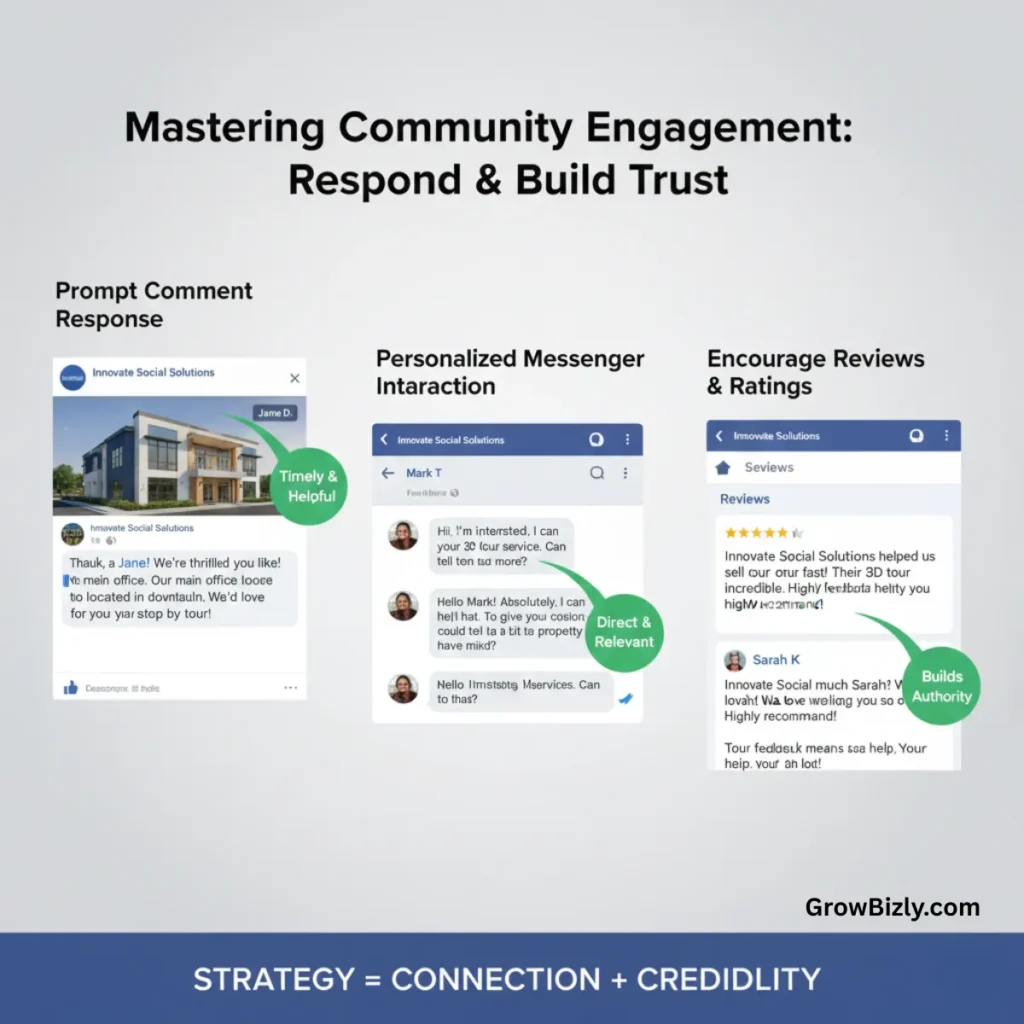
- Comments:Reply within the first 1–2 hours, if possible. Keep responses helpful, personal, and friendly. This encourages others to comment, increasing post reach.
- Messages: Use Meta’s automated chat responses to provide instant replies while keeping it personal. A well-handled Messenger interaction can turn a lead into a customer.
- Reviews: Encourage satisfied customers to leave reviews and always respond, even to negative feedback, professionally. Positive reviews improve your social proof, which is crucial for any Facebook marketing strategy.
📌 Pro Tip: Track your response rate in Meta Business Suite; it’s a KPI for both engagement and brand reputation.
Community Building with Facebook Groups
Facebook Groups are a goldmine for nurturing an audience and establishing authority.
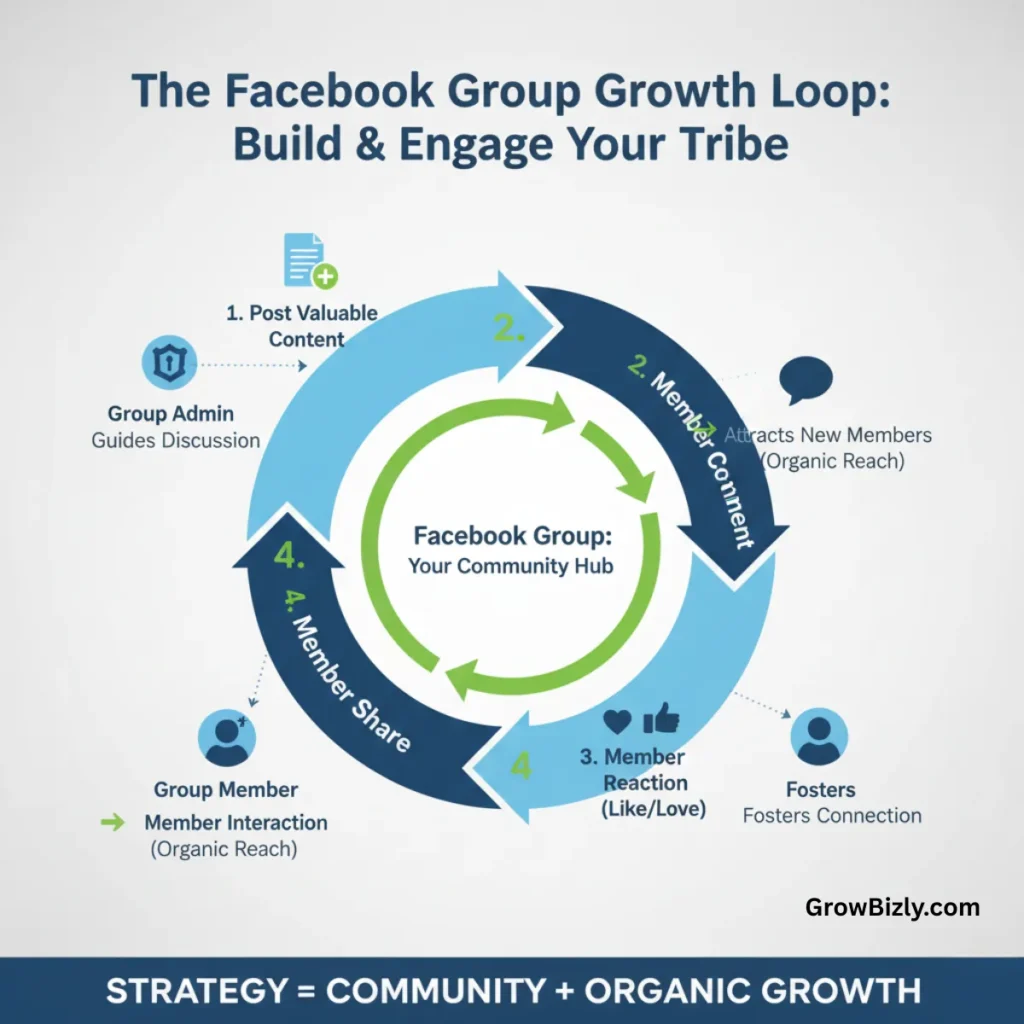
Why Groups Work:
- Builds a loyal micro-community around your brand
- Encourages discussions that organically boost post reach
- Provides feedback and insights straight from your audience
How to Use Groups Effectively:
- Create your own niche group tied to your brand or industry.
- Example: “Miami Real Estate Insider Tips” for real estate clients.
- Engage consistently with polls, questions, or exclusive content.
- Leverage Groups to drive traffic to lead magnets, events, or your main Facebook Page.
Groups complement your broader Facebook marketing plan, especially when combined with content and paid campaigns.
Step 5: Messenger Marketing & Automation (Converting Conversations into Leads)
In 2026, a marketing strategy in Facebook isn’t complete without Messenger. With over 1.3 billion active Messenger users, this channel enables businesses to engage directly, provide instant support, and drive conversions, all while reducing manual effort.
Automating Messenger with chatbots and personalization is no longer optional; it’s a key Facebook marketing technique that saves time and increases ROI.
Why Messenger Marketing Matters
- Immediate Engagement: Respond instantly to inquiries, building trust and reducing drop-offs.
- Lead Generation: Collect emails, schedule appointments, or push offers directly through Messenger.
- Retention & Loyalty: Use automated sequences to nurture existing customers with relevant updates and promotions.
Messenger acts as a bridge between your organic posts, ads, and Facebook marketing plan, turning casual visitors into leads and repeat customers.
Chatbots Setup: How to Get Started
- Choose a chatbot platform compatible with Meta (ManyChat, MobileMonkey, or native Meta automated replies).
- Define your goals: lead capture, customer support, or order collection.
- Map conversation flows: anticipate FAQs and key customer actions.
- Integrate with CRM: automatically send leads to your sales or email system.
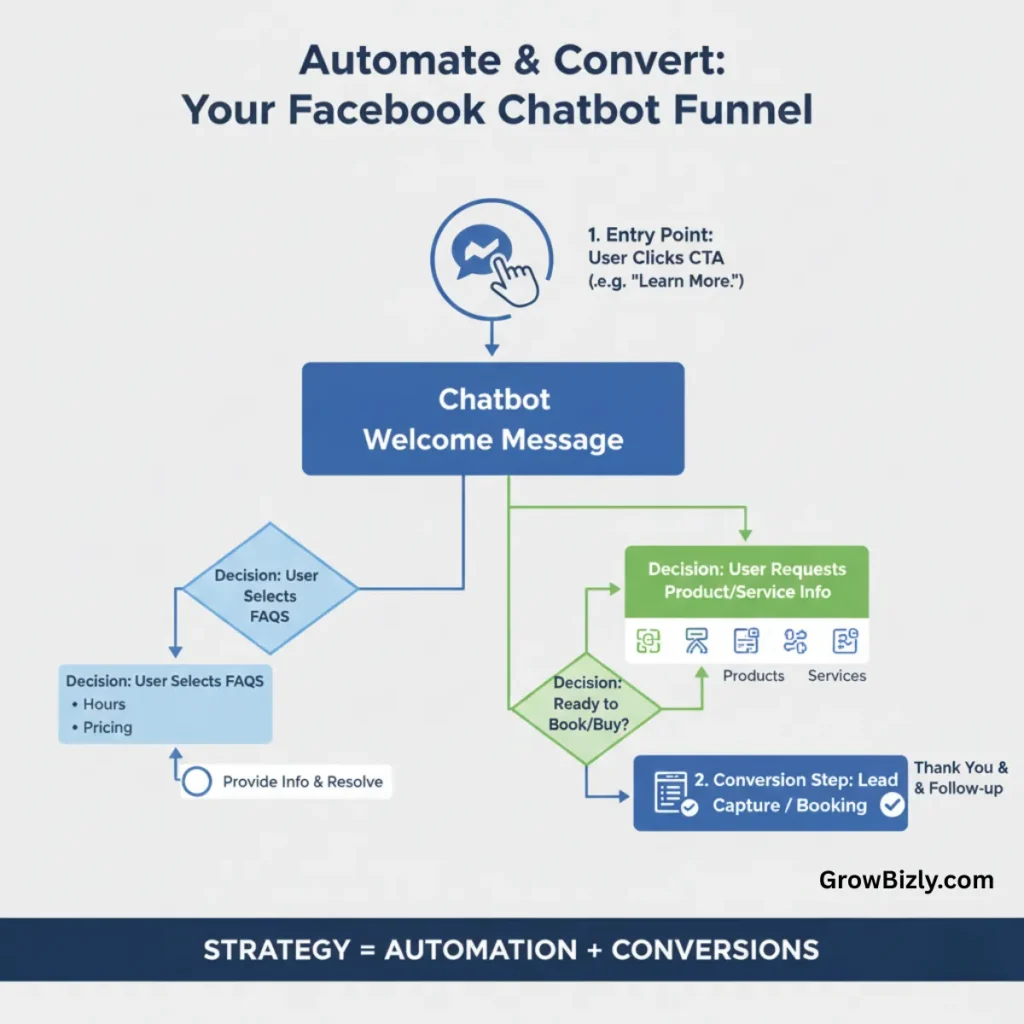
📌 Example Flow:
User clicks “Get Quote” → Bot asks qualifying questions → Provides personalized response → Captures lead info → Adds to follow-up sequence.
Personalization & Engagement Strategies
- Segmented sequences: Tailor messages based on user behavior or interest.
- Rich media: Include images, GIFs, or short videos in messages to increase click-through rates.
- Time-sensitive offers: Create urgency by adding limited-time promotions.
- Conversational tone: Keep responses friendly and human-like, avoid robotic scripts.
This approach aligns perfectly with Facebook marketing techniques, transforming automated chats into meaningful, revenue-generating interactions.
Step 6: Live & Video Marketing (Boost Engagement & Authority)
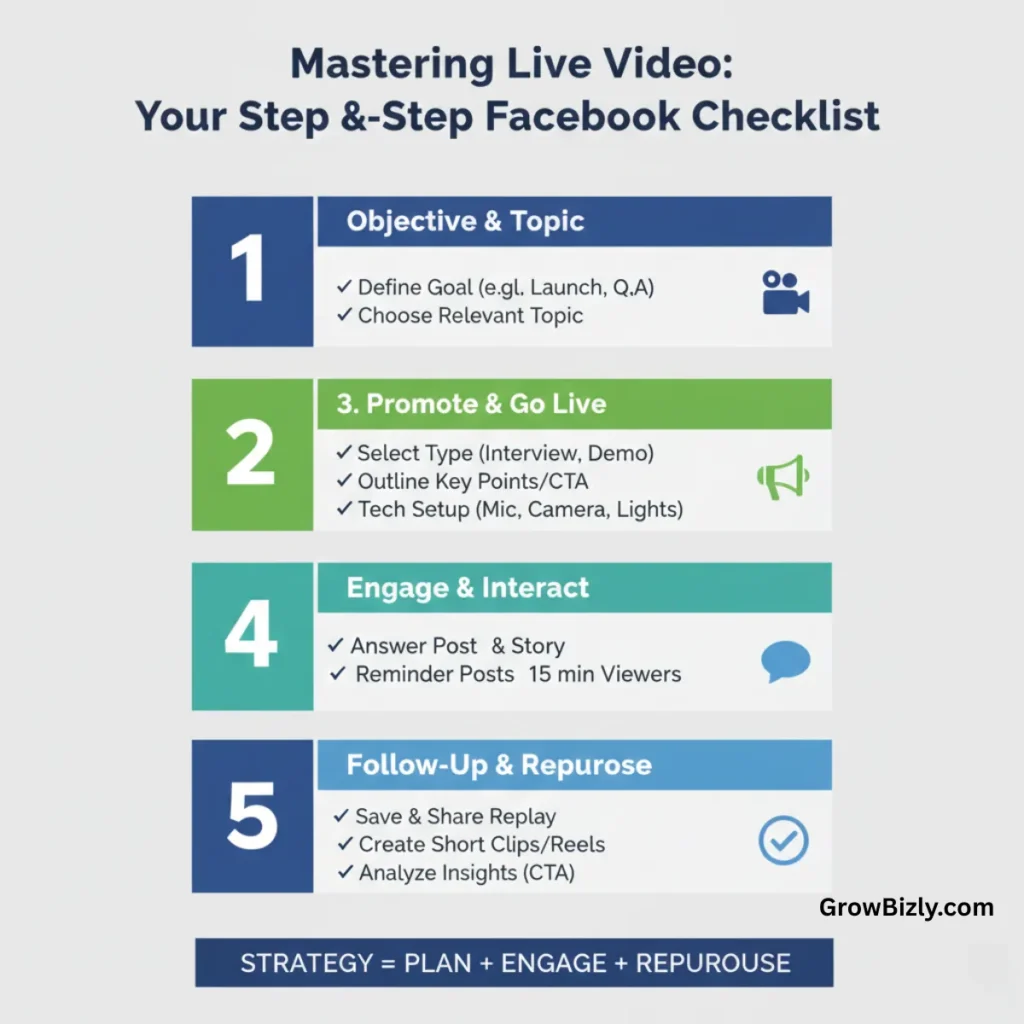
Video content is at the heart of a successful marketing strategy in Facebook. In 2026, Meta’s algorithm favours video, especially live sessions and short-form content, because it keeps users engaged for longer. Leveraging live streams and repurposing video content are key Facebook marketing techniques to maximise reach, engagement, and conversions.
Why Live Video Matters
- Authenticity & Trust: Live video humanizes your brand, showing the real people behind the business.
- Engagement Boost:Live streams generate 6x more interactions than pre-recorded videos do.
- Immediate Feedback: Answer questions in real-time, nurture leads, and address objections instantly.
📌 Example: A real estate agent can host a “Live Property Tour” or Q&A session about the buying process, driving both awareness and inquiries.
Planning Live Sessions
- Define your objective: Lead generation, product demonstration, or brand awareness.
- Choose the format: Q&A, interview, demo, or event coverage.
- Promote ahead of time: Use posts, stories, and email lists to announce the session.
- Prepare key talking points:Avoid ad-libbing and plan the flow for clarity and impact.
- Engage viewers actively: Call out comments, answer questions, and encourage shares.
Repurposing Video Content
Maximise every live session or recorded video by transforming it into multiple formats:
- Reels: Short 15–30 second clips with the best highlights.
- Stories: Quick tips, behind-the-scenes moments, or teasers.
- Ads: Use snippets as retargeting or conversion-focused campaigns.
- Posts: Full-length uploads with captions for local SEO and accessibility.
This strategy ensures each piece of content fuels multiple Facebook marketing tactics and strengthens your overall Facebook marketing plan.
Step 7: Track, Measure & Optimize (Maximising ROI on Facebook)
A marketing strategy in Facebook isn’t complete without rigorous tracking and optimisation. Data-driven insights help you understand what’s working, what’s not, and how to improve campaigns continuously. Measuring results ensures your Facebook marketing plan turns effort into tangible revenue.
Key Metrics to Track
To make informed decisions, focus on the following metrics:
- CTR (Click-Through Rate): Measures how well your content and ads capture attention.
- CPC (Cost Per Click): Helps you understand the cost efficiency of paid campaigns.
- Conversions: Tracks lead form submissions, purchases, or bookings.
- Engagement: Comments, shares, reactions, and video watch time indicate content resonance.
- Reach & Impressions: Measures visibility and growth potential.
📌 Tip: Track metrics at both ad set level and page/content level to identify high-performing strategies.
Tools for Tracking & Analytics
Meta provides robust tools for monitoring performance:
- Facebook Insights: Understand page-level performance, audience demographics, and engagement trends.
- Ads Manager: Track ad performance, ROI, CPC, CTR, and audience behavior.
- Meta Business Suite: Manage posts, schedule content, and consolidate insights across multiple pages and accounts.
These tools help you align your Facebook marketing tactics with your business objectives, ensuring your campaigns stay on target.
A/B Testing for Ads & Content
Testing is critical to refining your Facebook marketing plan:
- Test One Variable at a Time: Headlines, visuals, CTAs, or audience segments.
- Measure Performance: Compare engagement, CTR, and conversion metrics.
- Iterate & Optimize: Scale winners, pause underperformers, and apply learnings to future campaigns.
📌 Example: Test two versions of a property listing ad—one with a video walkthrough and one with carousel images. Track which drives more inquiries.
Niche Focus: Facebook Marketing Strategy for Real Estate
In 2026, a targeted Facebook marketing strategy for real estate can make all the difference between a few leads and a fully booked property pipeline. Real estate marketing thrives on hyperlocal targeting, visual storytelling, and lead capture, all of which can be executed effectively on Facebook.
Target Local Buyers with Hyperlocal Tactics
- Geo-targeting Ads: Focus on neighborhoods or cities where you have listings.
- Local Groups & Pages: Join community groups and post valuable content—market updates, events, or listings.
- Custom Audiences: Retarget users who engaged with previous posts, visited your website, or clicked on property listings.
📌 Tip: Hyperlocal targeting improves ROI while keeping ad spend efficient, a core component of a bright Facebook marketing plan.
Creative Post Ideas
- 3D Virtual Tours: Allow users to explore properties online; pair with call-to-action buttons like “Schedule a Viewing.”
- High-Resolution Videos: Short walkthroughs for Reels or Stories to increase engagement.
- Carousel Posts: Showcase multiple rooms, properties, or before/after renovations in one post.
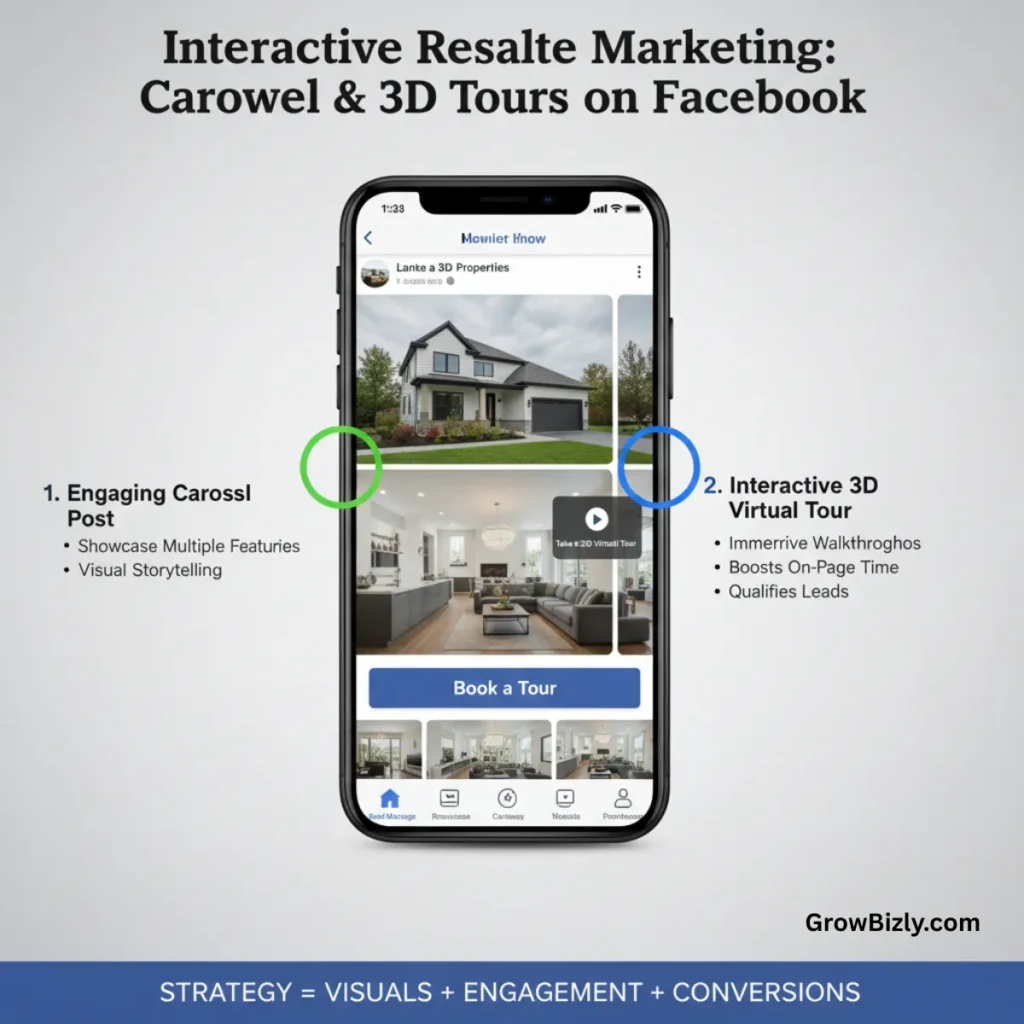
These tactics not only engage buyers but also strengthen your Facebook marketing content strategy by combining storytelling with actionable visuals.
Lead Magnets to Capture Buyers
Offer free, valuable resources to attract potential clients:
- Local Market Reports: Highlight trends, price changes, and hot neighborhoods.
- Home Buying Checklists: Practical guides for first-time buyers.
- Exclusive Webinar or Virtual Open House Access: Drive sign-ups directly via Messenger or lead forms.
Lead magnets help convert casual browsers into qualified leads, feeding directly into your Facebook marketing tactics.
Handling Special Ad Category Compliance
For real estate ads, Facebook enforces Special Ad Category rules:
- Avoid targeting by age, gender, or ZIP codes.
- Focus on interest-based, behavior-based, or lookalike audience targeting.
- Clearly label your ads as “Real Estate” in Ads Manager to maintain compliance.
Proper compliance protects your ads from rejection while still allowing effective hyperlocal targeting.
Mini Case Study / Example
Example:
A real estate agency in Miami ran a carousel ad showing three high-end apartments with a CTA: “Book a Virtual Tour.” Using custom audiences of local users who visited their site in the past 30 days, the campaign achieved:
- CTR: 1.25%
- Leads Generated: 45 qualified buyers in one month
- ROAS: 5x
This demonstrates the power of a strategic Facebook marketing plan for real estate, combining targeting, creative content, and lead magnets.
Common Mistakes to Avoid
Even the best marketing strategy in Facebook can fail if certain pitfalls aren’t addressed. Avoiding these mistakes ensures that your Facebook marketing plan drives engagement, leads, and conversions rather than wasting time and budget.
1. Over-posting or Under-posting
- Over-posting: Bombarding your audience with multiple posts per day can lead to content fatigue, lower engagement, and even unfollows.
- Under-posting: Infrequent posting makes your brand forgettable and reduces reach.
Solution: Stick to a consistent schedule, e.g., 3–5 quality posts per week, balancing educational, promotional, and social proof content.
2. Ignoring Analytics or Audience Engagement
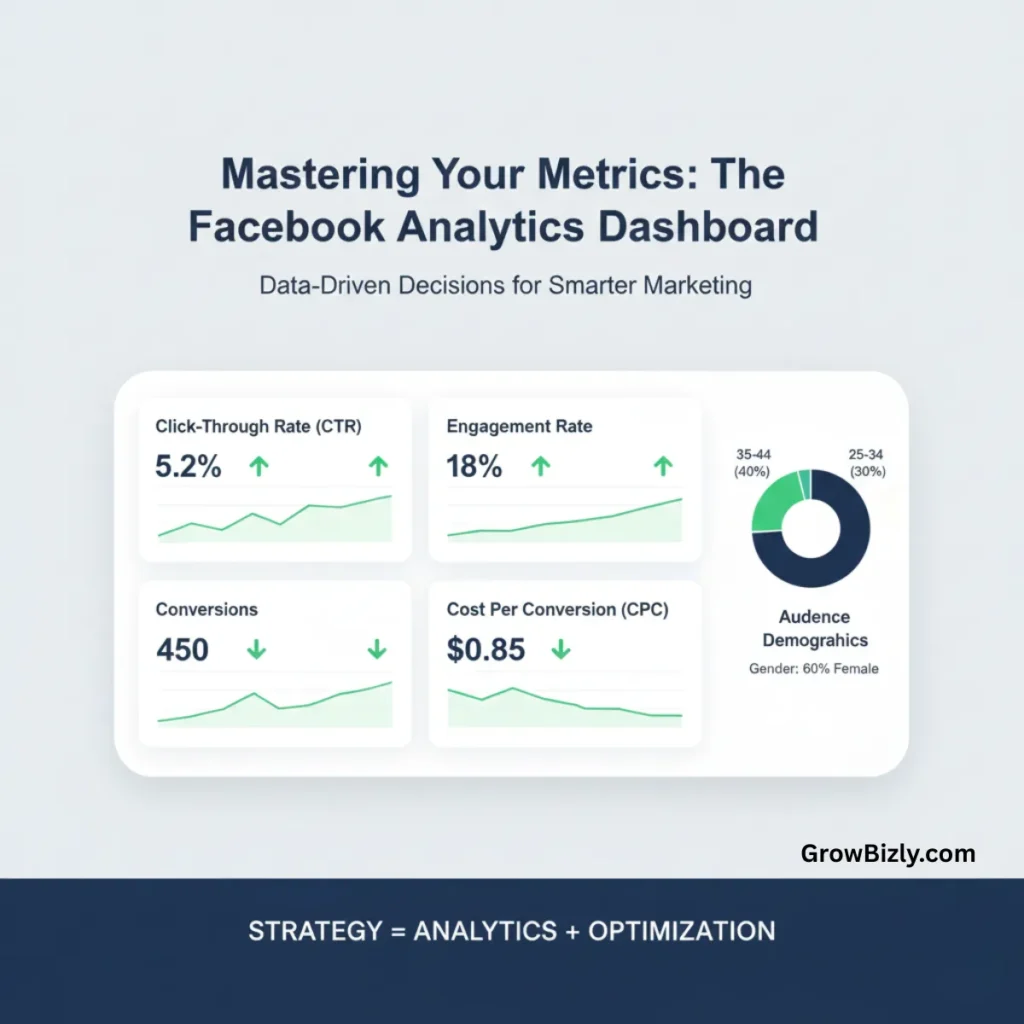
- Failing to monitor CTR, CPC, engagement, or conversions can leave you blind to what’s working.
- Ignoring comments or messages reduces trust and community building.
Solution: Use Facebook Insights, Ads Manager, and Meta Business Suite regularly. Respond promptly to messages and comments to foster loyalty.
3. Poor Ad Targeting
- Broad or irrelevant targeting leads to wasted ad spend and low conversions.
- Ignoring custom audiences, lookalike audiences, or retargeting limits ROI.
Solution: Use hyperlocal targeting, custom audiences, and retargeting in your Facebook marketing. Always test multiple audience segments.
4. Generic or Irrelevant Content
- Posting content that doesn’t resonate with your target audience reduces engagement and reach.
- Using stock images or repetitive messaging can make your brand forgettable.
Solution: Focus on high-quality visuals, storytelling, and value-driven content. Repurpose winning posts into Reels, Stories, or carousel ads to maximize performance.
Bonus Tips to Boost ROI
Even with a solid marketing strategy in Facebook, applying a few advanced tactics can significantly increase your engagement, leads, and conversions. Here are practical tips to take your Facebook marketing plan to the next level.
Retargeting Campaigns
- Why it works: Retargeting keeps your brand top-of-mind for users who have already engaged with your content or visited your website.
- How to implement:
- Use custom audiences from website visitors, video viewers, or lead forms.
- Show tailored ads highlighting products, services, or special offers.
- Combine with urgency-driven CTAs like “Book a Tour Today” or “Claim Your Free Guide.”
- Impact: Higher CTRs and conversion rates since you’re targeting an already interested audience.
Contests and Giveaways
- Why it works: Contests encourage shares, engagement, and virality, expanding your reach organically.
- How to implement:
- Offer free consultations, e-books, or small prizes relevant to your niche.
- Use entry mechanics that require users to comment, share, or tag friends, driving engagement.
- Ensure your contest aligns with your Facebook marketing tactics and goals.
Collaborating with Influencers
- Why it works: Influencers bring credibility, trust, and access to niche audiences.
- How to implement:
- Partner with local or industry-specific influencers for posts, Reels, or live sessions.
- Encourage them to share behind-the-scenes content or reviews of your service/product.
- Impact: Boosts social proof, engagement, and lead generation with minimal ad spend.
Using AI Tools for Personalization and Automation
- Why it works: AI helps scale personalized experiences without adding manual workload.
- How to implement:
- Use AI chatbots for Messenger marketing, automated responses, and lead qualification.
- Apply AI analytics tools to optimize Facebook content strategy, predicting which content will resonate most.
- Automate post scheduling and A/B testing for ads using Meta’s AI recommendations.
- Impact: Increases efficiency, improves user experience, and maximizes ROI.
Conclusion
A well-executed marketing strategy in Facebook transforms your social media presence from a passive page into a lead-generating, revenue-driving engine. By combining a clear Facebook marketing plan, creative content, smart ad targeting, and consistent engagement, businesses can:
- Increase brand awareness and credibility
- Generate qualified leads and sales
- Build a loyal and engaged community
- Measure and optimize ROI effectively
In short, a structured, data-driven approach ensures your Facebook efforts are strategic, measurable, and results-focused, rather than random or ineffective.
FAQs – marketing strategy in Facebook
How often should I post on Facebook?
For most businesses, the “sweet spot” is 1-2 posts per day. Quality always beats quantity; research shows that two high-value posts per week often generate more engagement than 20 mediocre posts. Focus on a consistent schedule your team can realistically maintain.
Can I automate my Facebook marketing strategy?
Yes, but with a hybrid approach. You should automate repetitive tasks like:
Scheduling: Using Meta Business Suite or tools like Hootsuite to queue posts.
Customer Service: Setting up AI Chatbots for FAQs and instant replies.
Reporting: Automating weekly performance data.
Note: Never automate your engagement (comments and replies to real people) because it can make your brand feel robotic.
How do I track ROI from Facebook campaigns?
Tracking ROI requires a three-step setup:
Meta Pixel & API: Install these on your website to track actions like “Add to Cart” or “Purchase.”
UTM Parameters: Use custom links for every post to see exactly which content drove traffic in your Google Analytics.
ROAS Calculation:Track your Return on Ad Spend (ROAS) in Ads Manager. While a common target is 4x (earning $4 for every $1 spent), your ideal ROAS may vary based on your profit margins.
What is the best content type for engagement?
In 2026, Carousels and Reels are the top performers.
Carousels see the highest engagement rates (approx. 0.36%) because they encourage users to “swipe.”
Reels are essential for reaching new audiences outside of your current followers.
Single Photos(especially authentic, non-stock images) remain effective for community building.